Other
VMware Workstation 17 Nested Home Lab Part 8: Setting up vSAN ESA
In Part 8 we install and configure the vSAN ESA into our Nested vSphere environment. We’ll do a quick review of the networking setup with vDS, some tips/tricks to setting up vSAN ESA, validate the ESA datastore, and enable the vSAN License key. All these steps will prepare us for Part 9 where we’ll run HCIBench to performance test our nested cluster.

VMware Workstation 17 Nested Home Lab Part 7: Setting up vSphere Environment
In Part 7 we start the setup of our vSphere environment and get it ready for the vSAN ESA Install. The steps we’ll cover are as follows – Power On all the systems, Ensure NTP, DNS, and network connectivity are working, Add License Keys, Create Datacenter and Cluster, Add Hosts to the cluster, Validate Host NTP Settings, and finally Suppress Shell and SSH Warnings.

#Optane #IntelXeon #Xeon #vExpert #VMware #Cloud #datacenter
VMware Workstation 17 Nested Home Lab Part 6: Installation of ESXi 8 Hosts
We’ve turned the corner on our series and in Part 6 we install ESXi 8 on to our Workstation 17 deployment. Additionally, I cover a few tips and tricks for getting the install to go smoothly!
#Optane #IntelXeon #Xeon #vExpert #VMware #Cloud #datacenter

VMware Workstation 17 Nested Home Lab Part 5: Installation of VCSA 8
In Part 5, I show you all the tips you’ll need to successfully install VCSA 8 on to Workstation 17.

#Optane #IntelXeon #Xeon #vExpert #VMware #Cloud #DataCenter
VMware Workstation 17 Nested Home Lab Part 4A/B
In Part 4A, I cover installing Windows 2022 Server, setting up AD, and DNS. Part B we complete the installation of Windows 2022 Server services (NTP, DHCP, RAS) and validate them. Towards the end of the video I make some adjustments to the DNS server allowing it to work properly.
#Optane #IntelXeon #Xeon #vExpert #VMware #Cloud #DataCenter

VMware Workstation 17 Nested Home Lab Part 3
In Part 3, I go over some OS Clean Up items, reviewing our network plan, and setting up Workstation 17 for the networks we’ll need. As motioned in the video check out @VMwareTAMLab for more information around alternative Windows AD/DS services.

#Optane #IntelXeon #Xeon #vExpert #VMware #Cloud #DataCenter
VMware Workstation 17 Nested Home Lab Part 1
In Part 1, I go into some of the Goals, Requirements, and a bit of planning around developing your own Nested Workstation environment by using mine an an example deployment.
Links in the video:
- ESXi Host Requirements
- vSAN Requirements
- VCSA Requirements
- Windows Server Requirements
- Workstation 17 Pro Requirements
- HCI Bench Requirements
- Guide PDF
#Optane #IntelXeon #Xeon #vExpert #VMware #Cloud #DataCenter
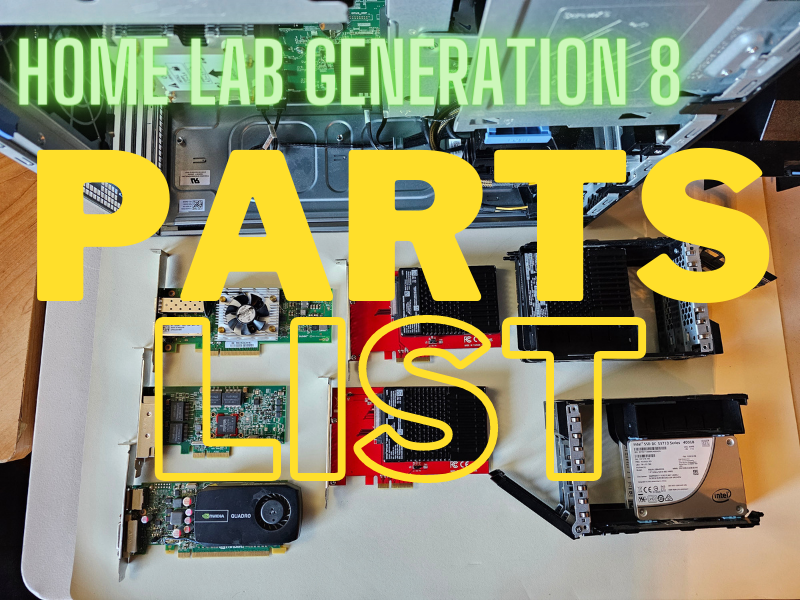
Home Lab Generation 8 Parts List (Part 2)
Today I’m releasing the parts that I plan to use for my Generation 8 Home Lab! I’ll be using three Dell T7820 Workstations for my ESXi Hosts. In this video I go through the BOM (Bill of Materials) or the parts I selected to build out my systems.
NOTE: Though I’ve installed ESXi 8 on these hosts, this in no way is my complete solution. For now ESXi 8 seems to run without issue but I have not tested it with vSAN ESA yet. I’ll be releasing more videos around settings and networking shortly.
UPDATE: 03/11/23 All parts seem to be working well though I’ve had a string of bad QLogic QL45212HLCU-DE 2 Port 25Gbe cards from eBay. After receiving 2 bad cards, I’ve decided to buy a new card from Server Supply. I’ve installed this card and its working fine. I recommend buying this card new vs. used. https://www.serversupply.com/NETWORKING/NETWORK%20ADAPTER/25%20GIGABIT/DELL/0NJFX_310672.htm
More and updated information can be found here – https://vmexplorer.com/home-lab-bom/ #intelxeon #optane #vmware #vexpert #cloud
Home Lab Generation 7: Archive Page
Today I’m retiring my Generation 7 Home lab as my Generation 8 lab will be posted in my Home Lab BOM section very soon. My Gen 7 Home Lab was a vSphere and vSAN 7 All Flash cluster and below was its final configuration. Some of the items below I’ll be reusing in Generation 8, and some of the items I will be selling off.
Overview:
My Gen 7 Home Lab is based on vSphere 7 (VCSA, ESXi, and vSAN), NSX-T, and vRealize Suite. Additionally, I use it for vSphere Nesting and Testing. It contains 3 x ESXi Hosts, 1 x Windows 10 Workstation, 4 x Cisco Switches, 2 x MikroTik 10gbe Switch, 3 x APC UPS, 1 x Synology 1621+, and 1 x Asustor Lockerstor 10. Read further below for an itemized list.
NOTE: My Home Lab Generation 7 design will not fully work with vSphere 8. Though I could force the install of vSphere 8 I have decided to upgrade my home lab. Please see my Home Lab BOM for more inforamtion.


ESXi Hosts: (Total cost for one host ~$1325 | Unless noted, the items this area are per host)
NOTE: This Home Lab Generation 7 has worked well for me with vSphere 7 BUT most likely it will need to be updated for vSphere 8 due to pCPU discontinuation. Please see this KB for further information https://kb.vmware.com/s/article/82794
- Case:
- Rosewill RISE Glow EATX (Newegg $54)
- Motherboard:
- Supermicro X9DRD-7LN4F-JBOD (Ebay $159)
- Mobo Stands: 4mm Nylon Plastic Pillar (Amazon $8)
- CPU: (These CPUs work on vSphere 7, but chances are they will NOT work with vSphere 8)
- 2 x Xeon E5-2640 v2 8 Cores / 16 HT (Ebay $30 each)
- CPU Cooler or Heatsink: (Bracket required to fit narrow 2011 cooler mounts)
- 2 x DEEPCOOL GAMMAXX 400 (Amazon $15)
- 2 x Rectangle Socket 2011 CPU Cooler Mounting Bracket (Ebay $16 for 5)
- RAM:
- 256GB DDR3 ECC RAM (Mostly from Ebay | each host has a different brand)
- 16 x Host1: ELPIDA 16GB 2Rx4 PC3L-10600R-09-11-E2 Registered ECC Memory DDR3
- 16 x Host 2: SAMSUNG M393B2K70CM0-YF8 16gb Pc3-8500r 1066mhz 1.35v Quad Rank X4 Ecc Registered Cl7 Ddr3 Sdram 240-pin Rdimm Memory Module For Server
- 16 x Host 3: HYNIX HMT42GR7BMR4C-G7 16gb Pc3-8500r 1066mhz Cl7 Quad Rank X4 Registered Ecc Ddr3 Sdram 240-pin Rdimm Memory Module For Server
- 256GB DDR3 ECC RAM (Mostly from Ebay | each host has a different brand)
- Disks:
- 1 x Dual M.2 PCIe Adapter Card for NVMe/SATA SSD (Amazon $15)
- 1 x 512GB NVMe SSD | vSAN Cache | Sabrent Rocket 512 (B&H $69)
- 1 x 240GB M.2 SSD | Boot Disk | Kingston A400 (Amazon $35)
- 2 x Supermicro AOC-SLG3-2M2 PCIe NVMe (Amazon $55)
- 2 x 2TB NVMe SSD | vSAN Capacity | Sabrent Rocket 2TB (Amazon $199)
- 1 x 2TB SATA | Extra Space | Hitachi (Ebay $50)
- 1 x Dual M.2 PCIe Adapter Card for NVMe/SATA SSD (Amazon $15)
- Network:
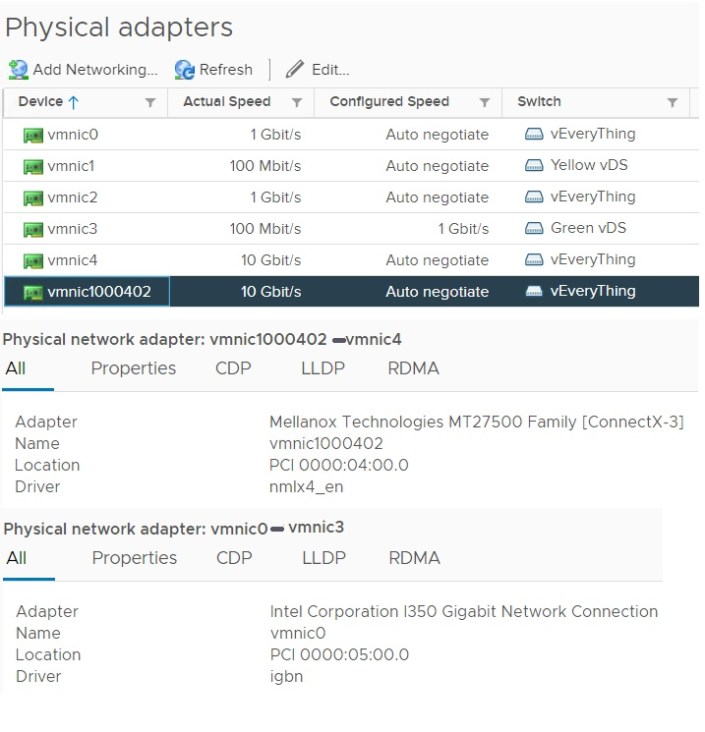
- Motherboard Integrated i350 1gbe 4 Port
- 1 x MellanoxConnectX3 Dual Port (HP INFINIBAND 4X DDR PCI-E HCA CARD 452372-001)
- Power Supply:
- Antec Earthwatts 500-700 Watts (Adapters needed to support case and motherboard connections)
- Adapter: Dual 8(4+4) Pin Male for Motherboard Power Adapter Cable (Amazon $11)
- Adapter: LP4 Molex Male to ATX 4 pin Male Auxiliary (Amazon $11)
- Power Supply Extension Cable: StarTech.com 8in 24 Pin ATX 2.01 Power Extension Cable (Amazon $9)
- Antec Earthwatts 500-700 Watts (Adapters needed to support case and motherboard connections)
Storage (NAS):
- Synology 1621+(Amazon $950)
- 2 x Synology 10Gb Ethernet Adapter 2 SFP+ Ports (E10G21-F2) (Amazon $270)
- 4 x 1Gbe Onboard
- 6 x 3TB SATA (Ebay $25ea)
- 2 x Synology M.2 2280 NVMe SSD SNV3400 800GB (Amazon $280)
- Asustor Lockerstor 10
- 2 x 10GBe Onboard
- 2 x 2.5Gbe Onboard
- 10 x 3TB SATA (Ebay $25ea.)
- 2 x Crucial P1 1TB 3D NAND NVMe PCIe Internal SSD (Amazon $129)
- Asustor Drivestor 2 P
- 1 x 2.5Gbe Onboard
- 1 x Asus (USB-AC56) Dual-band Wireless-AC1300 USB 3.0 (Amazon $70)
- 2 x 3TB SATA (Ebay $25ea)
Network:
- Core VM Switches:
- 2 x Cisco 3560 (WS-C3560CG-8TC-S 8 Gigabit Ports, 2 Uplink)
- 2 x Cisco 2960 (WS-C2960G-8TC-L)
- 10Gb Network:
- 2 x MikoTik 10Gb CN309 (Used for vSAN, NAS devices and Replication Network)
- 2 x DAC 1M used for 10Gbe Uplink between MikroTik Switches
- Several FLYPROFiber 10GBase-T SFP+ to RJ45
- 2 per host: HP 684517-001 Twinax SFP 10Gb 0.5m DAC Cable (Ebay)
- 2 per host: MELLANOX QSFP/SFP ADAPTER 655874-B21 MAM1Q00A-QSA (Ebay)
Battery Backup UPS:
- 1 x APC NS1250
- 2 x APC Back-UPS PRO BN1500M2
Announcing my Generation 8 Super VMware Workstation!
I’ve been using VMware Workstation for many years and its been a great tool to have in my home lab plan. Over the last couple of years, I had been using multiple computers to do various tasks (VMware Workstation, PC, PLEX, Video Editing, etc.) and they seemed to work okay. Most of these were older PCs I had around that I repurposed. However, a follower of my blog made a very generous donation of several key components. It was enough to really get me thinking about creating a SUPER Workstation box. I wanted to make an all in one workstation that could handle everything I currently supported plus more. I started to evaluate what I wanted to accomplish and created a simple goal list.
Goals:- Support for 3 different Networks:
- I wanted to have a 1Gbe and 10Gbe into my Home lab
- The other connection would be used for basic networking
- Run VMware Workstation:
- Support several PC VMs
- Support nested ESXi/vSAN 8 VMs, without having to force the install
- Have enough resources to run everything from one box
- Run PLEX Server
- I wanted to make sure I had enough HDD space to run my PLEX media
- Video Editing
- Support x16 PCIe Video Card
- From time to time I create videos and I wanted a system that could be performant around this.
From there I inventoried the parts I already had, chose new components, and created my Generation 8 VMware Workstation.
BOM:
- OS: Windows 11 Pro for Workstation
- VMware: VMware Workstation 17 PRO
- Case: Phanteks Enthoo Pro series PH-ES614PC_BK Black Steel
- Mobo: ASRack Rock EPC621D8A
- CPU: Xeon Gold 6252
- Cooler: Noctua NH-D9 DX-3647 4U
- RAM: 256GB (2933Mhz 2Rx4 ECC 4 x 64GB RAM)
- NVMe: 2 x Sabrent 2TB ROCKET NVMe PCIe
- SSD: Intel Optane 800GB P5800X
- HDD: 63TB 5 x Seagate IronWolf Pro 18TB
- Adapter: 3 x PCIe SSD U.2 Adapter
- VideoCard: GIGABYTE GeForce GTX 1650 SUPER
- SATA Cable: SATA 6G Data Cable
- 10Gbe NIC: ASUS XG-C100C 10G Network Adapter
- BluRay Drive: LG Blu-ray Disc Rewriter
- UPS: APC Back-UPS PRO BN1500M2
To better clarify some of my component choices I created this video and announced my DREAM #vmware #workstation
I’m sure it will be updated as time goes and my most recent Bill of Materials (BOM) can be found here. https://vmexplorer.com/home-lab-bom/
 vmexplorer